My father, shabbos candles and love
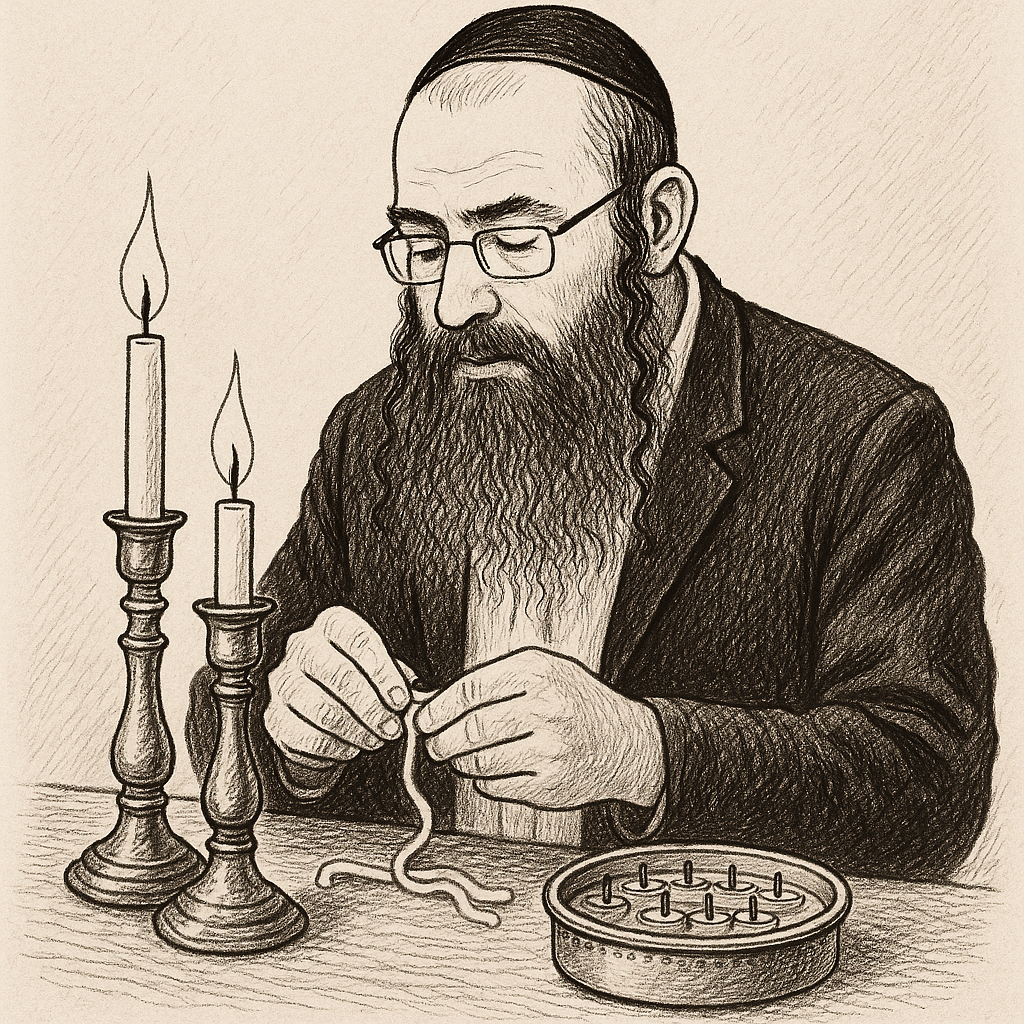
My father is rolling wicks for the Shabbos lights.
It’s Thursday night, and the dining room smells faintly of olive oil and wax. He sits at the table, a small pile of cotton wool in front of him, carefully pulling and twisting it into long, even strands. He knows exactly how a good wick should look, fine, but not too fine. Thick enough to hold oil, thin enough to burn clean.
The silver container is already waiting. Its round lid has ten small holes arranged like a crown. Each one holds a wick, one for every child. As each baby was born, a new wick was added. My father curls each finished wick into place and pours the oil over them, slowly, patiently. The white cotton swells and turns translucent. Then he takes a match and burns the tips, just a little, so they’ll catch more easily for my mother tomorrow.
It seems to me an act of love.
Whatever else was true – his rages towards me, the tension around him – I knew he loved my mother. I felt it in the way he prepared the wicks, this small, repetitive act. It felt good to me.
Each week, the wicks grew shorter. My father would trim the blackened ends until they needed replacing. I watched, learning to read the language of the flames. A thin, overstretched wick would flicker and fade. A well-made one would burn steady and bright all the way through. On Shabbos morning I’d come downstairs and examine the aftermath, the wax puddles, the shrivelled wicks in the silver oil container. Sometimes a flame went out early, leaving a half-burnt candle, a full, limp wick, behind. It always felt like a reflection of something in me.
Some weeks I felt strong. Some weeks thin and overstretched, like the wick wouldn’t catch. Like I would flicker out before the end.
We girls had to be present for candle lighting. Dressed in our Shabbos clothes, standing in the dining room. But we didn’t light. That was for married women with homes of their own. My mother lit two candles in silver candlesticks, then the ten wicks in the oil container. Circled her hands around them, covered her eyes and prayed.
And then my kiss. Once a week, a kiss on my mother’s soft papery cheek.
I introduced the ritual myself, sometime in my late teens. I don’t remember why. Maybe I read about it, maybe I saw someone do it. It felt like something normal families did. So I enlisted my sisters: after my mother lit the candles, we would kiss her. It was awkward at first, always awkward, really, but it became a ritual.
She wasn’t someone you could touch easily, my mother. She never hugged us, never kissed us. It was strange to think I had once lived inside her body, been fed from it. She felt like a distant object, foreign, untouchable. And yet, once a week, I would kiss her cheek.
Later, after I was married, I saw my husband’s mother light a tray of many wicks, not only one for each child, but also each grandchild. It took time to prepare. But in her home, it was a child who prepared them, not her husband. I remember thinking: No matter what, my husband will always prepare my wicks. Because that small act, rolling cotton, pouring oil, setting flame to tip, meant love. Or at least, I believed it did.
My father preparing my mother’s candles had come to stand for love, commitment, and care. I had absorbed the idea that acts meant love. So I brought that belief into my own marriage. I wanted visible signs of love and was determined to create them.
And more than that, I believed that once I was married, I would finally get love. Like my mother did. That was when love was supposed to arrive; that’s when devotion would begin.
So I built a cathedral of ritual in our home, small gestures, Shabbos routines, candle lighting, careful acts of care, all meant to symbolise what marriage and love looked like. I thought if I built it beautifully enough, love and devotion would follow.
But not only was my husband often cruel, he could only imitate rituals in a way that felt strangely childlike and hollow. As if he were copying without understanding. I saw what I had created reflected back to me, distorted and empty. It was like watching a child play house, sweet, maybe, but not real.
The gestures were there, but the emotional current wasn’t. And the rest of the marriage came with a lot of pain. It was confusing. Wasn’t this the formula? Hadn’t I followed it?
I began to see that ritual alone wasn’t enough. I had inherited a belief system – acts equal love – without ever learning to ask whether this was true. Whether I was truly seen, truly cherished. I wanted rituals to carry the weight of love. But rituals can’t substitute for real connection. They can only express what’s already there.
I kept trying to make love happen through effort and devotion, the way I’d seen my mother do, the way my father did. It would take years before I began to ask: What do I want love to mean? And is love what I believe it to be?
I found myself having to re-learn love. Re-examine everything I had been taught about it.
As a child, I seemed to have been deliberately taught about love by my father. For him, love and devotion were important. My father would say to us: we have love, even if we don’t have money or kavod (prestige). He’d list examples of other families whose parents were always fighting, or cold towards each other. Among his siblings, he told us, he was the only one close to his spouse. And it seemed to me that my parents were devoted to each other. So I internalised the idea that love looked like that: a husband doing things for his wife, a wife who was loyal and devoted.
That we children loved our parents was taken for granted. We were told that we loved them, and they loved us, even when it didn’t feel like it, when they were cruel, neglectful and violent. Our love was a fact, and not something that needed to be earned or questioned.
It never occurred to me that I might not love my mother, that her cruelty, lashing out and meanness might not deserve my love. That my father’s beatings, put-downs and verbal tirades might mean that I shouldn’t love him. And that the opposite was also true, that their behaviour towards me might mean the opposite of love. In our family, we loved each other. That was the rule.
I was taught to see their love for each other, and overlook what wasn’t love at all, in fact what was truly harmful, towards me.
Love, I learned, was service, ritual, acts of devotion between parents and from children towards parents. That’s why I introduced the kiss, an invented ritual meant to express what I thought love was meant to look like.
That was the version of love I absorbed. That love was something people could demand of you by virtue of your role. That it had little to do with emotional safety or joy, and everything to do with duty, loyalty, and performance. I believed love was proved through action.
I see now how that became the trap: because my parents treated each other with a certain kind of love, I was taught to believe this was how love worked. And I was taught to ignore the absence of love in how they treated me. In absorbing their version of love, I never received it. I was trained to look away.
I had never considered not loving. I didn’t know love could have boundaries. That it could be mutual, safe, or earned. I didn’t know you could stop loving someone who hurt you, or choose not to love someone, that you didn’t have a duty to love someone just because they were family.
I had to spend years re-learning love, retraining my nervous system to recognise true love and care. To believe it was acceptable for love to be real, not performative and ritualised. To focus on the deeper meaning, on how it felt, and whether it was freely chosen, and had strong boundaries.
Nowadays I have a very different view of love.
Perhaps my father did love my mother, and she him, in their way. I wouldn’t recognise it as love now myself. But of this I’m certain: they didn’t love me. And I don’t have to love them, or anyone else. I can stop performing love to survive.
Part of me still wants to honour that child and see that there was something simple and beautiful and loving in the way my father prepared my mother’s Shabbos lights. I note how the image still tugs at my heart, and I say to myself, there were good times. This was real. It all seems simple and pure and true.
But the other, more protective part of me, thinks of that young girl, watching him, learning his version of love, and sees the raging, vicious tormentor that he was towards me, and my siblings. And it knows that the child was not allowed to truly hold the full picture. The child had to look away, and not know. She was taught to split off that part that knew and suffered.
Now, very gently, I bring these two parts together.
I reflect how this splitting is a theme that ran through most of my early life. Indeed, it was built into the religion itself, into the shabbos candles that this memory has revived. In lighting the candles, there was a clear split between everyday life and Shabbos. In that moment, peace was a fact, a ritual one. You were not permitted to even think about pain, suffering, and problems. It was mandatory to be happy. Thus the religion was a larger container for the same thing.
And my father preparing the shabbos candles, and my mother lighting them, adds another layer to this splitting, ritualising it.
Joining things together is hard. Holding the love and the cruelty, the beauty and the violence, the ritual and the reality doesn’t come naturally. I’m trying not to split, not to idealise or erase, but to see all of it at once. I’m trying not to choose one version and silence the rest, but hold it all together in its entirety.