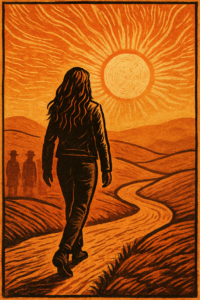
 Even after I was cast out of the Chassidic community of Stamford Hill, London, it took me a while to recognise that I fit the description of someone the charedim labelled as having gone off the derech—off the path. In my mind, that label was reserved for people who had abandoned Judaism entirely. But I hadn’t. I was still deeply connected to it. I wanted more.
From a young age, I was a profoundly spiritual child—conscientious and earnest. I believed in God as I was taught, a kind of father in the sky, one who laid down rules and spoke through the men in black hats and payos. The sacred language of God stirred something deep within me.
That spiritual hunger followed me into adulthood. Even as I searched for my own way, trying to understand who I truly was and how I belonged, I never felt I was turning away from God or from spirituality. On the contrary, I immersed myself more deeply in Jewish learning and found myself falling more in love with it. The childish image of a dictating sky-father gave way to a more complex, human-centred understanding but I still really liked what I found.
I longed for more: more room to participate, more space to express, more connection to the divine. Yes, I began to question. I saw how group psychology, inherited trauma, power hierarchies, and mysticism had shaped the community I grew up in. I realised some rules weren’t necessary for spiritual growth—and some were even damaging. But everything I questioned came from a place of yearning for something true and sacred.
My journey brought moments of mystical insight, experiences that expanded my inner vision. I grew a deeper, more mature, more relationship with the divine. And I was still Jewish. Why wouldn’t I continue my spiritual journey within Torah and Judaism?
That’s why it was so devastating when Torah seemed to vanish from the people I had lived among—family, friends, neighbours—many of whom had known me all my life. The moment they believed I had departed from their version of Torah, it was as if nothing held them back. The ethical teachings disappeared. Torah no longer bound them. The shock was enormous. That a rebbe could sanction my persecution, the theft of my property, the harm to my children—in the name of Torah.
I believed they knew better. They had studied the same sacred texts. Surely, I thought, they too held Torah dear. Even if they believed I had strayed, surely they would stay within the lines the Torah itself draws. But instead, they weaponised it. And in doing so, they revealed just how far they had strayed from what Torah is truly meant to be.
I am, and have always been, certain that what they invoked was not Torah. It was something else—something twisted and hollowed out. Their entire framework was corrupted. This wasn’t just a misreading; it was a betrayal of the essence of Torah.
This is why dialogue has never been possible. It’s why things remain so painfully stuck with my children. You can’t have a conversation about Torah with those who live its opposite.
I remember being taught that the devil can come disguised in religious clothing. I didn’t understand then how true that was. The most disturbing part? The devil doesn’t even know they’re the devil.
One of the things I did that helped me was create something that brought me clarity and healing: a Teshuvah Manual—a document that outlines what the Torah actually says about what was done to me. Writing it was illuminating. It’s available under another menu heading, if you want to explore it.
I’ve had many confirming experiences, but I’m not here to persuade anyone. The truth has its own gravity and I don’t need to defend it. It settles into us when we’re ready—when we’re not too cut off. And sin cuts us off. That part of the Torah is profoundly true.
Let’s start from this place: not assuming that they represent true Torah, and therefore that Torah itself is broken—but recognising that they don’t. They need to do teshuvah. Real teshuvah. That’s the only way they’ll ever reconnect to what Torah really is.
As for me, I’ve made peace with the label. Off the derech? Maybe. I don’t follow Torah or Judaism as a spiritual path anymore, mainly because of the traumatic associations it has for me now. But spirituality and the divine? I’ve come to see that I was always, in the deepest sense, on a path toward what is real. I will forever be grateful that my life brought me to a place where I can express my deepest spiritual self and feel so whole and connected.
So come with me. Join me as I tell my story.